
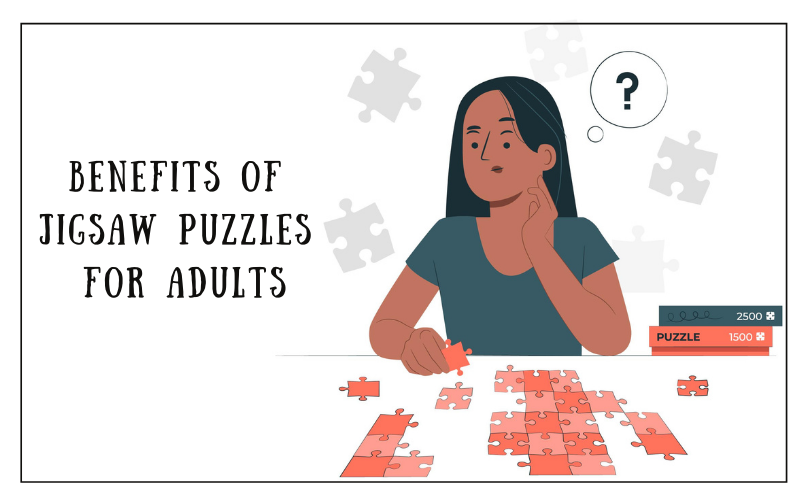
Play is important for children as well as adults. And the riddle is no exception! There are many studies that show the spiritual benefit of children’s puzzles. In this article, we will discuss further the benefits of solving puzzles for adults.
So, let’s get started!
One, the puzzle promotes focus and relaxation.
By doing a riddle, we focus on what we’re doing and we separate ourselves from reality. That is why many adults associate riddles with a time when they can almost “pass all things aside. ”
For some, the riddle helps them to relax, for others, not so much. So we view the puzzle as one of the many options, like the puzzle, the color, the wool, the Sudoku puzzle, etc. that you can experiment to find your tense hobby!
Neural stimulation
Solve puzzles can be a form of brain training. We make the conscious mind work by stimulating different areas. The riddles are an effective way to reduce our perceptive powers.
Many studies show that intellectual games are good for both children and adults. Also, when we really focus on a single activity, sometimes we do another kind of clean-up in our heads. Suddenly we find out, without realizing it, new solutions to a problem.
Three. Be Sensitive
To succeed in solving a puzzle, you have to be able to observe their specific pieces and shapes. With children, we encourage them to be small explorers as they go looking for a certain piece. Kids understand that they need to gather clues to complete the puzzle. In adults too, the puzzle allows us to work on our perception: we have to visualize a mental image.
4 A Great Way to Show Patience
The real riddles test our patience while forcing us to persevere because it is almost impossible to be quick and dynamic when handling them! The more pieces, the harder it is to complete the puzzle. The puzzles help you to be more patient.
In addition, the riddle also helps us not to give up too quickly and easily. Sometimes we also need to remind ourselves that things are not immediate.
An Education Tool for Learning
The puzzle is a great educational tool. They are excellent learning tools that allow you to learn in a really physiological way. On the one hand, there are riddles that can help you deal with geography, but others can help you learn new forms or improve mathematics!
Six. A great way to observe, analyze and predict
Formating the shape and color of the toy was built, analyzing the path of a piece in the maze, placing a sequence of puzzles, etc. All these activities can help you improve your ability to observe to a whole new level. They also allow us to predict, thinking by asking ourselves: ‘ If I do and act that way, what will happen? ”
7 Development of Memory
When a child or an adult solves a puzzle you have to solve many acts such as grouping, separation or unraveling the issue, you will develop a better memory to recall the actions you need to take. It is an activity that even older ones tend to recall matters. The riddles are indeed an excellent mind stimulator!
8, Encourage Focus and Skill
Focus is another benefit that puzzles bring. To complete this activity, a person needs to concentrate fully on what he is doing. In terms of skill, this skill is essential, since some games require good motor skills and coordination.
Nine, improving eye coordination
If you ever seriously solve puzzles, you know what we’re talking about. The puzzles require a close coordination of mind and body, and in the process, they will improve it to a certain extent.
Ten. Increase confidence
Seeing your riddles in their shape is very rewarding. The results are visible immediately. It is a source of pride to pursue something and succeed in carrying it out. When you feel you’re improving, the brain releases dopamine, the hormone is happy. This happiness helps you to become more confident in life.
Eleven. Developing the Spirit of Cooperation
When the whole family solves a puzzle together, people will support each other. It is a shared source of joy that makes everyone feel useful in the game together. A good result of this activity is the development of a united spirit within each family member.
12 Be Smarter
Neural research shows that solving puzzles greatly improves the brain, visual and spatial skills, such as perception, flexibility, working memory, speed, etc. With age, neural connections tend to harden. Solve puzzles that stimulate toughness.